
“Success” doesn't always mean control.
YouTube scriptwriter and course creator George Blackman looked successful from the outside. He had a flagship course, Pro community, and a wildly popular email course, but inside he felt like he was “drowning under the weight" of what he built.
He had no clear offer ladder, no funnel visibility, and zero bumps or upsells.
So together we rebuilt his offer architecture, how interfaces with customers, and built a high-ticket offer.
Today, George is in more control than ever.
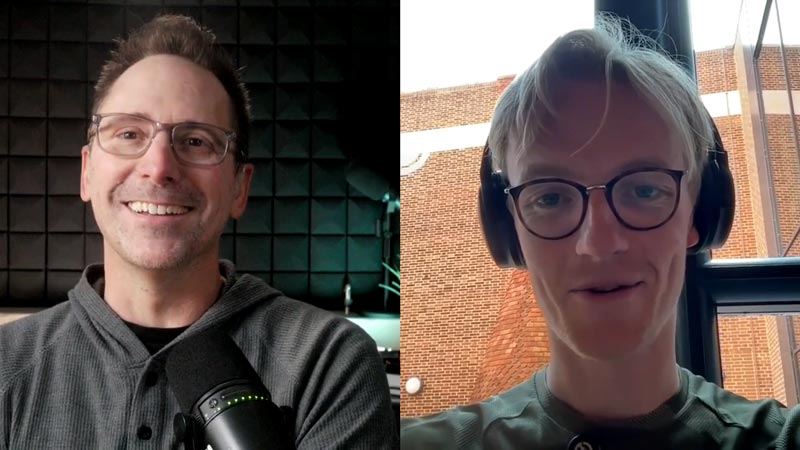
George and I first met under some unusual circumstances.
George and I met in the most unexpected way. He'd opened up his calendar to talk with aspiring editors while building out his scriptwriting agency. I booked time with him, but instead of pitching my services, I showed up with a rough plan for how he could grow his business.
As we talked, I could sense something beneath the surface. His business was working, but it was starting to crush him.
He had built something genuinely impressive: a respected course and community for YouTube scriptwriters, relationships with big channels and well-known creators, and his flagship program, Scriptwriting Playbook, was selling consistently. His free 5-day email course was bringing people into his world, he was writing a regular newsletter, and he had a couple of digital products humming along in the background.
On paper? Success.
On one of our early calls? This:
"I feel like I'm starting to drown under the weight of the things that I've built. I don't feel on top of this stuff anymore."
Here's what we did together to turn that around. Now George says:
"I just feel so in control for the first time, it's amazing. So I cannot thank you enough!"
George's World Before We Started
George is an accomplished YouTube scriptwriter and educator. If you've watched creator channels that genuinely care about storytelling and structure, there's a good chance you've seen his fingerprints on their videos.
When we started working together, his business had some solid pieces:
- Scriptwriting Playbook, his main course for YouTubers who want to write better scripts
- A Pro community where buyers could get deeper support and office hours
- A free 5-day email course that distilled the first module of the program
- A regular newsletter
- Two small products: a database of retention-graph breakdowns and a script template
Revenue was coming in. Students were getting value. He was genuinely proud of what he'd built.
The problem wasn't "does any of this work?"
His problem was that he couldn't answer basic questions about how it all fit together:
- How are people actually discovering me?
- What paths are they taking into the course and into Pro?
- Am I undercharging my best customers?
- Have I made this too complex, and if so, where do I simplify?
When he tried to think about next year's plan, he felt "lost in the quagmire" of his own assets. Everything was working a little bit. Nothing felt like it was working on purpose.
He wasn't short on effort or ideas. He was short on structure.
What Was Really Going On
As we dug into his situation, a few things became clear.
First, he was flying blind on customer insight. Apart from community office hours, George rarely sat down with customers to ask how they'd discovered him, why they'd bought, what nearly stopped them, or what had actually changed for them. His understanding of the buyer journey came from open rates, Twitter replies, and his gut.
Second, he had assets but no architecture. Yes, there was a flagship course, a Pro community with 6-month and 12-month options, a free email course, a newsletter, and those small products. What he didn't have was a clear offer ladder. No simple picture that showed: this is how people typically start, this is the natural next step, and this is how we deliberately deepen the relationship over time.
Third, his funnel was essentially invisible. ConvertKit handled emails. Gumroad sold some assets. Lemon Squeezy processed course and community payments. Circle hosted the community. Each piece knew its own little part of the story. Nobody could see the whole thing, including George.
Finally, his mental model of growth was limited. In his head, the only serious levers were: re-record the course, do another big launch, or keep it evergreen and hope for the best. Concepts like order bumps, upsells, and structured ascension weren't foreign to him. They just weren't present in his system in any intentional way.
So we started with the foundation: understanding reality instead of speculating about it.
Step 1: Replace Guessing With Real Customer Insight
Before touching his offer structure, we needed to stop flying blind.
I wrote a customer interview script specifically for Scriptwriting Playbook and his audience. It covered how buyers first discovered him, what was going on when they decided to get serious about scripting, which other options they considered, what sold them on his course, where they got confused, and what new problems appeared after implementation.
I asked him to run a handful of 20-30 minute calls, record them, and get full transcripts. From there, we used an AI tool to analyze those transcripts for recurring themes like the real trigger moments, the language buyers used to describe their pain, and the specific modules they pointed to as turning points.
That gave him something he hadn't had before: a way to make decisions about copy, offers, and next products based on what people actually said, not what he imagined they were thinking.
Step 2: Map the Offer, Not Just the Course
Once we had real signal from customers, we zoomed out and laid his offers out on the table.
I walked George through my Offer Map framework. We took everything he currently sold and placed it into the most appropriate spots. The picture that emerged was revealing.
He had a solid core: the course and the Pro community with two tiers. There were a couple of light bonuses baked into the course experience.
But there were no order bumps at checkout. There were no upsells offered immediately after purchase. There were no structured downsells for people who weren't ready for Pro but wanted more than the course. There was no deliberate surprise-and-delight moment designed into the journey.
The core product was strong, but the architecture around it was barely there.
The point wasn't to overwhelm him with what was "missing." It was to give us a clear list of opportunities we could either ignore for now or design against. The most important shift was explicit: moving from no bumps or upsells at all to a concrete path for adding new ones that made sense for his customers.
Step 3: Turn the Funnel Into Something You Can Actually See
With the offer pieces clearer, we turned to flow.
We started by building a simple revenue model in a spreadsheet. It tracked how many units of each tier he was selling, what the average order value looked like at each level, and what happened to his numbers if we introduced small changes like an inexpensive add-on at checkout.
Then we created a visual funnel map. Nothing fancy, just a clear diagram that showed where people came from, how they entered his world, what they saw next, where the community was presented, and where the small products sat in relation to the main offer.
The goal wasn't a pretty flowchart. It was a living map George could pull up and understand. By the time we were done, he no longer had to keep all of this in his head. There was a single place he could look to answer "how does someone go from stranger to Pro member in my world?"
Step 4: Build Ascension Paths Instead of New Products
George already had a natural ladder in his business. Many people started with the course, a smaller group joined Pro, and a few naturally wanted more from him. None of that was formalized.
We wrote explicit paths:
- A path from Essential to Pro, so buying the course felt like the beginning of the relationship, not the end
- A path from 6-month Pro memberships to 12-month renewals, with a plan for communicating value
- A path from "happy course buyer" to "candidate for future high-touch offers"
We also explored different delivery models that matched his temperament. George realized that one-off live calls to stare at scripts on Zoom drained him. Asynchronous feedback, where he could think deeply and respond thoughtfully, felt far more sustainable. That insight shaped how we framed any future VIP or high-ticket options.
Ascension stopped being an abstract idea. He had specific offers, at specific points in the journey, designed for specific kinds of students.
Step 5: Go From No Bumps/Upsells to a Real Roadmap
At the start, there were no order bumps or upsells in George's checkout flow. If you bought the course, you got the course. That was it.
By the time we finished, he had a realistic, prioritized roadmap of both.
On the order bump side, we identified small assets that would be obvious wins: his retention-graph database, a polished script template pack, a set of AI prompts to diagnose draft scripts, and editor Q&A recordings. The key wasn't just "what exists," but "what belongs at checkout, at a modest price, that deepens the main promise without overwhelming people?"
On the upsell side, we focused on the Pro community and extending Pro memberships. That meant making the upgrade from Essential to Pro a natural part of the buying experience rather than something people might trip over later.
We then slotted these into the funnel map: which bumps belonged on the initial course checkout page, which upsell should appear immediately after purchase, and which offers made more sense as follow-ups via email or inside the community itself.
He didn't just walk away with a list of ideas. He walked away with a sequence, and a place for each piece to live.
Step 6: Treat Partnerships As a Channel, Not a Bonus
By this point, George had already had meaningful touchpoints with people like Ali Abdaal's Part-Time YouTuber Academy, Colin & Samir, and Spotter. His name was being mentioned in the "right rooms," but there wasn't yet a consistent structure for what happened when their audiences crossed paths with his work.
We designed that. We discussed how his course could appear in someone else's funnel as an upsell. We talked about what a guest session would need to do to feel like a natural bridge into Scriptwriting Playbook. We outlined what a partner-specific landing page should say so that someone coming from Ali Abdaal's Part-Time YouTuber Academy would feel immediately "seen."
The idea was simple: if George is already the "script guy" inside other people's ecosystems, his business should be ready to receive and serve those students smoothly.
What Changed
George now has a living offer map and a living funnel map. He no longer has to hold everything in his head or dig through half a dozen tools to remember how his system works.
He has a repeatable customer insight process so that when he wants to improve a page, design a bump, or think about a new offer, he can start from his customers' words instead of his assumptions.
He's moved from treating each course sale as the finish line to designing clear ascension paths into Pro, into longer Pro memberships, and into more intensive support for those who want it.
And he's gone from having no bumps or upsells at all to a grounded, realistic plan for adding both in a way that fits how he likes to work and what his students actually want.
When we first spoke, he described himself as "drowning under the weight" of what he'd built. Now, when he looks at his business, he can see what he has, how it connects, and which levers to pull next.
If You Recognize Yourself in George
You don't need more ideas.
If you're like George, you already have a flagship offer that works, a handful of related products or assets, and a trickle (or a flood) of opportunities and channels.
What you're missing is a coherent system. A way for those pieces to work together so that every new buyer has somewhere obvious to go next, and every new partnership has somewhere solid to land.
That's the work I do with clients like George: we architect the offer, the funnel, and the ascension around what already works, so you can make one decisive business move in the next 90 days that actually changes how the machine runs.
If you'd like to explore that, you can learn more about working together here.
George Blackman is the author of The YouTube Scriptwriting Playbook and leader of The YouTube Scriptwriter's Community.

Results may vary. Past client successes reflect individual efforts and unique circumstances; they don't guarantee similar outcomes. Your results depend on personal commitment, market conditions, and other variables.
How it works
If you're tired of the guesswork and costly mistakes of going alone, I'll help you:
This is not a “talk about your business forever” coaching program.
This is a focused engagement that helps you make one key decision and ship it.